
Convenient and Affordable: Water Delivery Services for College Apartments
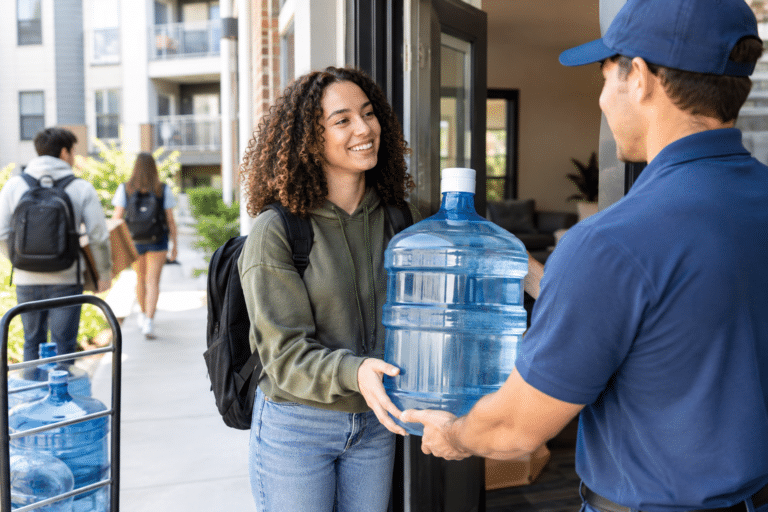
A water delivery service gives colleges, universities, and student apartment communities a convenient way to provide reliable drinking water without requiring students or housing staff to transport heavy cases from stores. With scheduled delivery, flexible ordering, and scalable fulfillment, campuses can improve resident convenience while reducing logistical demands on housing operations.
Water Delivery for Student Housing
- Convenient: Students can have drinking water delivered directly to their residence or designated campus location.
- Scalable: Programs can support individual students, residence halls, or large apartment communities.
- Operationally efficient: Housing teams spend less time coordinating individual deliveries and student requests.
- Student-focused: Convenient amenities can contribute to a more comfortable residential experience.
- Flexible: Delivery programs can be structured around student demand, campus schedules, and housing configurations.
- Potentially revenue-generating: Universities can explore program structures that create additional value for students while supporting housing initiatives.
- Easy to integrate: Water delivery can complement other student services offered through a centralized housing-services provider.
Why Water Delivery Matters in College Apartments
College students increasingly expect convenience in the places where they live. Residence halls and student apartments are no longer viewed simply as places to sleep. They are an important part of the overall campus experience.
Providing access to convenient drinking water can address a surprisingly practical problem: students need water regularly, but transporting heavy bottles or cases can be inconvenient, particularly for students without cars.
For university housing departments, the challenge is finding ways to offer useful amenities without adding unnecessary work for already busy staff.
A professionally managed water delivery program can provide a practical solution.
Instead of requiring housing employees to manage inventory, answer student questions, coordinate individual deliveries, or organize distribution, universities can partner with an experienced student-services provider to establish a structured program.
The result can be a more convenient residential experience without creating another major operational responsibility for housing staff.
How Water Delivery Services Work in Student Apartments
A well-designed water delivery service can be adapted to the way a university’s housing system operates.
Depending on the program, students may be able to arrange deliveries through an established ordering process, while the service provider manages fulfillment and delivery logistics.
A typical program may include:
- Student enrollment or ordering
- Selection of delivery preferences
- Scheduled fulfillment
- Delivery to an approved location
- Customer-service support
- Recurring delivery options where appropriate
The exact model can vary according to campus policies, apartment layouts, security requirements, and student demand.
For a university with several thousand residents, scalability is particularly important. A program that works for a small apartment community should also have the infrastructure to accommodate higher demand during move-in periods or other predictable seasonal peaks.
Delivery Models for Different Campus Environments
Not every campus needs the same approach.
Housing Environment | Potential Delivery Approach | Primary Benefit |
Traditional residence halls | Designated campus delivery locations | Simplified logistics |
Apartment-style housing | Residence-specific delivery | Greater student convenience |
Large residential campuses | Centralized ordering and scheduled fulfillment | Scalability |
Private student housing | Resident-focused delivery program | Amenity differentiation |
Mixed housing communities | Flexible delivery options | Accommodates different resident needs |
The best approach is one that balances student convenience, campus logistics, security, and operational simplicity.
Benefits of Water Delivery for College Students
1. Students Avoid Carrying Heavy Cases
A case of bottled water can be awkward to transport, especially for students walking from a retail store or using public transportation.
Students living several floors above ground level may also have difficulty carrying multiple cases to their rooms.
Delivery removes much of that inconvenience.
For students without vehicles, international students, first-year students unfamiliar with the surrounding area, and residents with demanding academic schedules, having essential items delivered can make everyday life easier.
2. It Saves Students Time
College schedules can be unpredictable.
Students balance:
- Classes
- Studying
- Employment
- Athletics
- Clubs and organizations
- Social activities
- Internships
- Campus responsibilities
An amenity that saves even a small amount of time can provide meaningful value when repeated throughout the semester.
3. It Improves the Residential Experience
Small conveniences can influence how students perceive their living environment.
A residence hall with useful, easy-to-access services can feel more supportive than one where students must independently solve every logistical problem.
Water delivery can therefore become part of a broader strategy focused on student satisfaction and residential convenience.
Benefits for University Housing Departments
The advantages extend beyond students.
Housing and residence-life departments frequently operate with limited personnel while managing thousands of residents.
Every additional service can potentially create more administrative work unless responsibilities are clearly defined.
A professionally managed water program can help reduce that burden.
Potential operational advantages include:
- Fewer individual student logistics requests
- Less need for housing staff to manage water inventory
- Reduced storage requirements
- Centralized service coordination
- Predictable delivery schedules
- Professional customer support
- A scalable solution for growing residential populations
The key is establishing clear responsibilities from the beginning.
Housing staff should not have to become the default customer-service department for a third-party amenity.
Water Delivery as a Student Housing Amenity
Student housing operators compete not only on room layouts and pricing but also on the overall resident experience.
Amenities can help differentiate one community from another.
For private student housing properties, a convenient delivery program can become part of the property’s broader amenity offering.
For universities, it can complement other student services such as:
- MicroFridge® rentals
- Student storage
- Bunk solutions
- Laundry-related services
- Move-in programs
- Package management
- Other residential convenience services
When services are coordinated through fewer providers, housing teams may be able to simplify vendor management while giving students access to a broader range of conveniences.
Creating a Cost-Effective Water Delivery Program
Affordability should be evaluated from both the student perspective and the institutional perspective.
A low-cost service is not necessarily the best value if it creates substantial administrative work.
Likewise, a premium service may not be appropriate if students are unwilling to use it.
A practical evaluation should consider:
Student Cost
Evaluate the price students pay compared with the alternatives available near campus.
Delivery Frequency
Determine whether students need one-time deliveries, recurring deliveries, or seasonal options.
Campus Demand
Estimate the percentage of residents likely to participate.
Staff Requirements
Determine exactly how much housing staff involvement will be necessary.
Storage
Establish whether the program requires campus storage or whether inventory remains with the provider.
Customer Support
Clarify who handles questions, missed deliveries, changes, refunds, and other service issues.
A Simple Cost-Benefit Framework
Factor | Questions to Ask |
Student affordability | Is the service reasonably priced compared with local alternatives? |
Staff workload | How much administrative involvement is required? |
Scalability | Can the program accommodate hundreds or thousands of students? |
Convenience | Can students easily order and receive deliveries? |
Reliability | Are delivery schedules predictable? |
Support | Who handles student service issues? |
Revenue opportunity | Can the program support housing or student-service initiatives? |
This type of evaluation helps decision-makers look beyond the sticker price.
How Universities Can Improve Adoption
Even an excellent service will have limited impact if students do not know it exists.
Successful campus programs should be introduced as part of the student experience rather than buried in a housing webpage.
Consider promoting the program through:
- Housing orientation materials
- New-student communications
- Move-in information
- Residence-life newsletters
- Student portals
- Parent communications
- Residence-hall signage
- Campus social media
- Welcome-week materials
Timing also matters.
Introducing the service before move-in gives students and parents an opportunity to understand their options before they arrive on campus.
Make Ordering Simple
Students are more likely to use a convenience service when the process is straightforward.
The ideal experience should minimize unnecessary steps.
Clear information should explain:
- What is available
- How much it costs
- Where deliveries can be made
- When deliveries occur
- How students place orders
- How recurring deliveries work
- Who to contact with questions
Reducing friction can make the difference between a service students appreciate and one they simply ignore.
Supporting Parents During the College Transition
Parents are another important audience for student housing amenities.
Moving a student into college can involve dozens of decisions, from bedding and furniture to storage, appliances, transportation, and everyday necessities.
Convenient delivery options can give parents one less logistical issue to worry about.
For families sending students to a campus far from home, this can be especially valuable.
Parents may appreciate knowing that their student has convenient access to everyday essentials without requiring family members to make frequent trips to the store.
This makes water delivery more than a simple convenience—it can contribute to a smoother transition into independent college living.
Information to Gather Before Launching a Campus Program
Before implementing a new water delivery program, housing administrators should evaluate the operational environment.
Review the following:
- Number of residential students
- Number and type of housing communities
- Apartment access policies
- Delivery restrictions
- Security procedures
- Storage limitations
- Move-in and move-out schedules
- Student communication channels
- Existing campus vendors
- Anticipated participation
- Customer-service expectations
A pilot program can also be useful.
A university might begin with one residence community, measure participation and satisfaction, identify logistical issues, and then expand the program across additional properties.
This approach creates an opportunity to validate demand before committing to a campus-wide rollout.
Why a Single Student-Services Partner Can Make a Difference
Managing several student amenities through multiple vendors can create administrative complexity.
Each vendor may have different:
- Contracts
- Billing procedures
- Customer-service processes
- Delivery schedules
- Reporting requirements
- Campus contacts
A centralized student-services partner can simplify coordination.
For housing leaders, the value is not necessarily having the largest number of amenities. It is having useful services that can be implemented and managed efficiently.
A water delivery program can become particularly attractive when it fits into a broader student-services strategy.
The Bigger Opportunity: Building a Better Student Housing Experience
Water delivery is only one piece of a larger student-housing strategy.
The strongest residential programs consider the entire student journey:
Move-in → Daily Living → Academic Year → Breaks → Move-out
Each stage creates different needs.
During move-in, students may need appliances and essential supplies.
During the academic year, they may value convenience services.
During summer, storage and logistics become more important.
At move-out, students need practical solutions for belongings and transportation.
When universities think about student housing as an integrated experience rather than a collection of individual services, they can identify opportunities to improve convenience while reducing unnecessary operational friction.
Partner With University & Student Services
University & Student Services (USS) helps colleges and universities provide practical solutions designed around the realities of student housing.
From water delivery and student storage to MicroFridge® rentals and other residential services, a coordinated approach can help institutions improve convenience while reducing the burden placed on housing teams.
For universities evaluating new student amenities, the right question is not simply, “Can we offer this service?”
It is:
“Can we offer it in a way that is convenient for students, manageable for staff, and scalable for the institution?”
A thoughtfully implemented water delivery program can help answer that question while creating another practical touchpoint in the student residential experience.
Contact University & Student Services to explore student-focused solutions for your campus housing program.
Frequently Asked Questions About Water Delivery for College Apartments
Is water delivery a good amenity for college apartments?
Yes. Water delivery can provide students with convenient access to drinking water while helping housing communities differentiate their residential experience.
How can universities manage water delivery without increasing staff workload?
Universities can work with a dedicated service provider that manages ordering, fulfillment, delivery, and customer support while campus staff maintain defined oversight responsibilities.
Can water delivery programs support large universities?
Yes. A scalable program can be structured to serve individual apartment communities, residence halls, or larger student populations depending on campus requirements.
Can parents order water for college students?
Depending on the provider and program structure, parents may be able to purchase or arrange delivery for students, providing an additional convenience during the college transition.
Can water delivery be combined with other student services?
Yes. Water delivery can complement services such as student storage, MicroFridge® rentals, and other housing-related solutions, potentially allowing institutions to streamline vendor relationships.