

College students often want to eat better, spend less on takeout, and make their schedules a little easier. The challenge is that traditional dorm rooms are not designed for full-scale meal preparation. Students may have limited kitchen access, little counter space, and strict residence hall policies regarding cooking appliances.
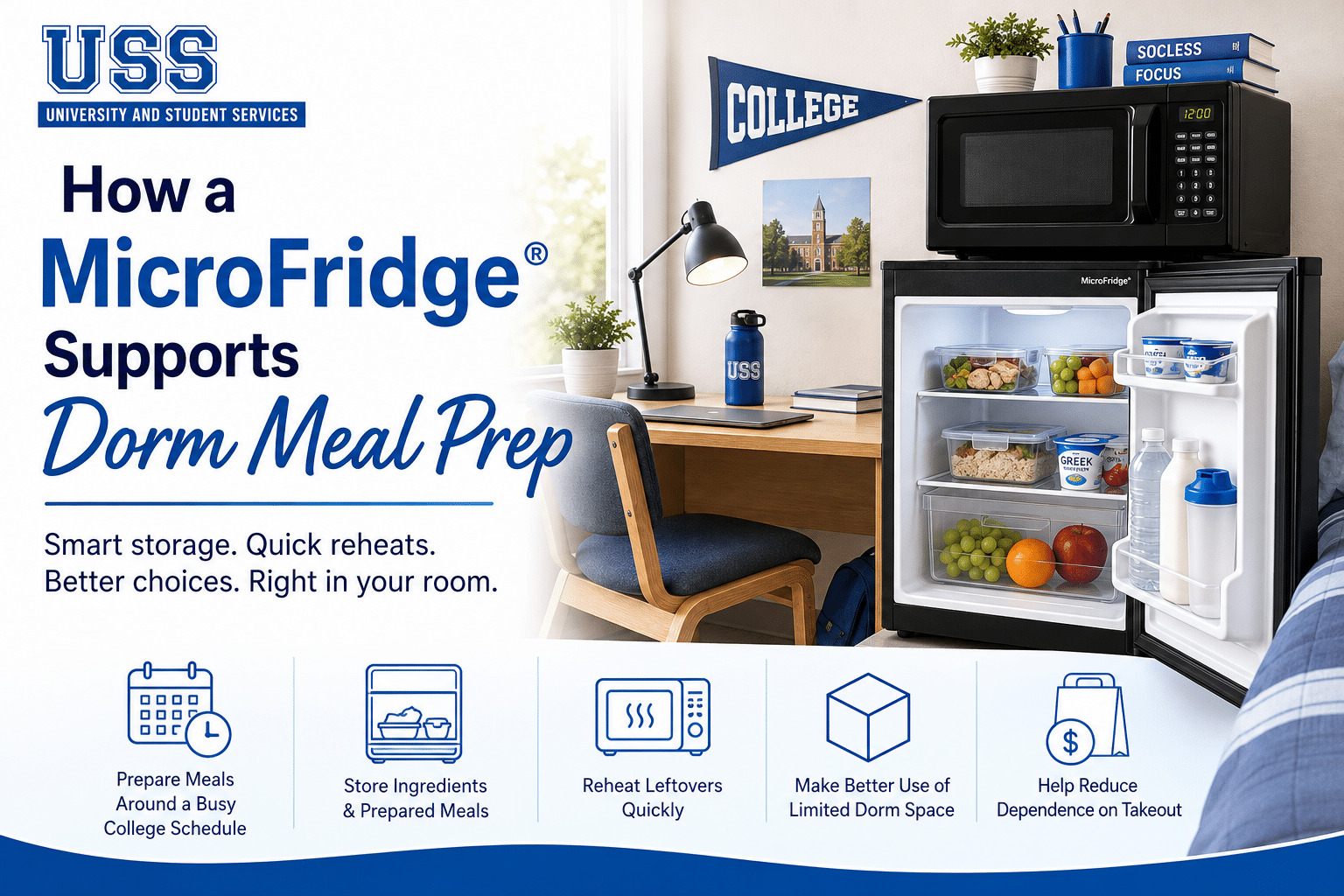
A MicroFridge® provides a practical solution by combining essential food-storage and heating capabilities in a compact unit designed for student living. With a refrigerator and microwave in one space-saving appliance, students can keep ingredients fresh, prepare simple meals, reheat leftovers, and maintain a more flexible eating routine without needing a full kitchen in their residence hall room.
For universities and student housing departments, MicroFridge® rental programs can also add convenience and value to the residential experience while supporting student needs within the space and operational limitations of campus housing.
Why Meal Prepping in a Dorm Can Be Challenging
Meal prepping typically requires three basic capabilities: food storage, food preparation, and reheating. In a traditional apartment or home, students would have access to a refrigerator, microwave, stove, oven, countertop, and other kitchen equipment.
Dorm living is different.
Students often have to work within a much smaller footprint. A shared community kitchen may be located several floors away, while campus dining hours may not always align with a student’s class schedule, study sessions, work commitments, or extracurricular activities.
Even when a residence hall provides communal cooking facilities, students may not want to carry ingredients, containers, utensils, and prepared meals back and forth.
A MicroFridge® helps address part of this challenge by putting refrigeration and microwave heating within convenient reach.
That makes it easier for students to build simple meal-prepping habits around the equipment and space available to them.
What Is a MicroFridge®?
A MicroFridge® is a compact appliance system that combines a microwave and refrigerator into one student-friendly unit.
Instead of requiring separate appliances to occupy valuable dorm room space, the integrated design provides two essential functions in one footprint.
The refrigerator can be used for storing items such as:
- Fresh fruit and vegetables
- Yogurt and dairy products
- Sandwich ingredients
- Prepared meals
- Leftovers
- Beverages
- Snacks
- Condiments
The microwave provides a convenient way to heat foods such as:
- Oatmeal
- Rice and grain bowls
- Soup
- Pasta
- Frozen meals
- Steamed vegetables
- Baked potatoes
- Leftovers
- Microwaveable breakfast foods
The exact foods and preparation methods students can use will depend on the residence hall’s rules, the appliance model, and applicable safety requirements.
How a MicroFridge® Supports Dorm Meal Prep
1. Prepare Meals Around a Busy College Schedule
College schedules rarely follow a predictable nine-to-five routine.
Students may have early classes, afternoon labs, evening activities, part-time jobs, athletic commitments, or long study sessions. Dining hall hours may not always fit conveniently into those schedules.
Having a refrigerator and microwave in the room can provide additional flexibility.
Students can prepare or purchase food when their schedules allow, store appropriate ingredients or leftovers, and reheat meals later.
This can make meal prepping in a dorm more realistic without requiring students to prepare elaborate recipes.
2. Store Ingredients and Prepared Meals
Refrigeration is one of the most important components of basic meal planning.
Students can portion meals in advance and store them for later use, provided foods are handled and refrigerated safely.
For example, a student might prepare several portions of a simple meal using a campus kitchen or another approved cooking area. Those portions can then be stored in the refrigerator and reheated as needed.
This approach can reduce the temptation to purchase food every time hunger strikes.
It can also make it easier for students to maintain consistent eating routines during particularly demanding weeks.
3. Reheat Leftovers Quickly
Leftovers are one of the easiest ways to simplify student meals.
Instead of preparing something from scratch every day, students can prepare food in an approved kitchen, purchase a prepared meal, or save suitable leftovers from a previous meal.
A microwave makes reheating fast and convenient.
For students balancing classes, studying, and other responsibilities, the ability to reheat food directly in their dorm room can save time and eliminate unnecessary trips to another part of campus.
4. Make Better Use of Limited Dorm Space
Space is one of the biggest considerations in residence hall living.
Students may already need to fit a bed, desk, clothing, school supplies, storage containers, and personal belongings into a relatively small room.
Adding multiple standalone appliances can quickly consume valuable floor or countertop space.
The integrated MicroFridge® concept addresses this issue by combining two commonly needed functions into a single unit.
For university housing teams, this can also create a more consistent and manageable appliance solution across residence halls.
5. Help Students Reduce Dependence on Takeout
Frequent takeout can become expensive over the course of a semester.
Students who have convenient access to refrigerated foods and reheating capabilities may find it easier to keep simple meals and snacks available in their rooms.
A student does not need to become an expert cook to benefit from meal preparation.
Simple options can include overnight oats prepared using approved ingredients, yogurt and fruit, sandwiches, salads, microwaveable grains, soups, leftovers, and other foods appropriate for the student’s residence hall policies.
The objective is not to turn a dorm room into a full kitchen. Instead, it is to give students practical food-storage and reheating options that complement campus dining and approved cooking facilities.
Easy Dorm Meal Prep Ideas Using a MicroFridge®
Meal prep in a residence hall should generally focus on simplicity.
Breakfast
Students can keep breakfast items such as yogurt, fruit, oatmeal, milk, and other refrigerated foods available for busy mornings.
A microwave can make certain breakfast foods easier to prepare or reheat when permitted.
Lunch
Prepared grain bowls, sandwiches, salads, soups, and leftovers can provide convenient lunch options.
Students can portion meals in reusable containers and store them for later use.
Dinner
Dinner does not always require complicated cooking.
Students can combine prepared ingredients or leftovers with microwaveable foods to create quick meals. When cooking is necessary, students should use designated campus kitchens or other facilities approved by the university rather than attempting prohibited cooking methods in their rooms.
Snacks
A dorm refrigerator can also support a variety of convenient snacks, including fruit, yogurt, vegetables, cheese, and other appropriately refrigerated foods.
Keeping nutritious snacks available can make it easier to avoid relying exclusively on vending machines or late-night food delivery.
Meal Prep and Student Budgeting
Food costs can add up quickly for college students.
Meal prepping can help students make more deliberate decisions about what they purchase and when they eat it. Instead of buying individual meals throughout the day, students can plan several meals or snacks in advance.
A MicroFridge® can support this strategy by giving students a place to store food and reheat prepared meals conveniently.
For universities, providing this capability as part of student housing can also contribute to the overall residential experience. Students receive a practical amenity that supports everyday living rather than simply another piece of furniture or equipment.
A MicroFridge® Is Not a Replacement for a Campus Kitchen
It is important to view a MicroFridge® as a complement to campus dining and approved cooking facilities rather than a replacement for a full kitchen.
Students should always follow their university’s residence hall policies regarding food preparation, appliance use, food storage, and fire safety.
A microwave can handle many convenient heating tasks, but it does not provide the same capabilities as a stove or oven. Foods requiring conventional cooking should be prepared in an appropriate approved facility.
This distinction allows students to take advantage of the convenience of in-room refrigeration and microwave heating while still using campus kitchens when more extensive meal preparation is necessary.
Why Universities Can Benefit From MicroFridge® Programs
The advantages extend beyond individual students.
For University and Student Services departments, an effective residence hall appliance program can support convenience, student satisfaction, and the functionality of campus housing.
A standardized MicroFridge® program can provide universities with a consistent appliance solution across designated residence halls.
It may also help student housing teams establish clear expectations around appliance use and room amenities.
For universities looking to improve the student residential experience, the combination of refrigeration and microwave functionality addresses two common student needs within a compact footprint.
MicroFridge® Rental for College Students
A MicroFridge® rental program can give universities another way to provide convenient in-room amenities without requiring students to purchase and transport individual appliances.
For students, rental availability can simplify the move-in process.
Instead of deciding which compatible appliances to purchase, students can access an approved solution through their university’s established housing program, depending on campus availability.
For university administrators, centralized rental programs can also make appliance distribution and management more consistent.
The specific rental terms, models, availability, and residence hall policies will vary by institution.
How to Make Dorm Meal Prep Easier
Students can get more value from their MicroFridge® by adopting a few practical habits:
- Plan several meals at once. Choose simple foods that can be stored and reheated conveniently.
- Use appropriate food-storage containers. Labeling meals can make organization easier.
- Keep the refrigerator organized. Avoid overcrowding so food can be stored properly.
- Buy realistic quantities. Purchase enough food for the week without creating unnecessary waste.
- Keep easy staples available. Simple ingredients can become quick meals when time is limited.
- Use approved cooking facilities. Follow all residence hall rules for cooking and appliance use.
- Clean the appliance regularly. Keeping the refrigerator and microwave clean supports a better living environment.
- Coordinate meal prep with your schedule. Prepare food during less busy periods so meals are ready when classes and activities become demanding.
Make Student Living More Convenient With MicroFridge®
Dorm living does not have to mean giving up every aspect of meal planning.
With convenient access to refrigeration and microwave heating, students can store prepared foods, keep simple ingredients available, reheat meals, and build practical routines around demanding college schedules.
For universities, a MicroFridge® program can provide a useful residential amenity while making efficient use of limited student housing space.
Looking for a convenient appliance solution for your residence halls? University and Student Services teams can explore how a MicroFridge® rental program can support student convenience, simplify in-room food storage and reheating, and enhance the overall campus living experience.
Connect with our University and Student Services team to learn more about MicroFridge® solutions, rental options, and how an appliance program can fit your campus housing needs.
Frequently Asked Questions About Meal Prepping With a MicroFridge®
Can you meal prep in a dorm room with a MicroFridge®?
Yes, a MicroFridge® can make basic dorm meal preparation more convenient by providing refrigerated food storage and microwave heating in one compact unit. Students should follow their university’s rules regarding which foods and preparation methods are permitted in residence halls.
What foods can students keep in a MicroFridge®?
Students can generally use the refrigerator for appropriate refrigerated foods such as fruit, yogurt, vegetables, dairy products, sandwiches, beverages, and prepared meals. Food should always be stored and handled according to applicable food-safety guidance.
Can you cook meals in a MicroFridge®?
A MicroFridge® microwave can heat or prepare certain microwave-compatible foods, but it is not a replacement for a conventional stove or oven. Students should follow the appliance manufacturer’s instructions and their university’s residence hall policies.
Is a MicroFridge® useful for college students?
Yes. The combination of a refrigerator and microwave provides two convenient functions that can be particularly useful for students living in residence halls with limited space and kitchen access.
Does a MicroFridge® save space in a dorm room?
The integrated design can help conserve space compared with having separate refrigerator and microwave units because two functions are incorporated into one appliance system.
Can students store meal-prepped food in a MicroFridge®?
Students can store appropriate prepared foods in the refrigerator when the food is handled and stored safely. Meal-prepped foods should be refrigerated promptly and managed according to food-safety recommendations.
Is a MicroFridge® good for students who are trying to save money on food?
Having convenient food storage and reheating capabilities can make it easier for students to plan meals, use leftovers, and reduce reliance on spontaneous takeout. Actual savings depend on food choices, dining plans, and individual spending habits.
Can universities provide MicroFridge® units to students?
Many universities use dedicated appliance programs to provide students with refrigerator and microwave solutions. Availability, rental arrangements, models, and eligibility vary by institution.
What should students consider before meal prepping in a dorm?
Students should review their residence hall’s cooking, food-storage, appliance, and fire-safety policies. They should also consider available refrigerator capacity, food-safety practices, storage containers, cleaning requirements, and access to approved campus kitchens.